

The Impact of Normative Message Types on Off-Trail Hiking
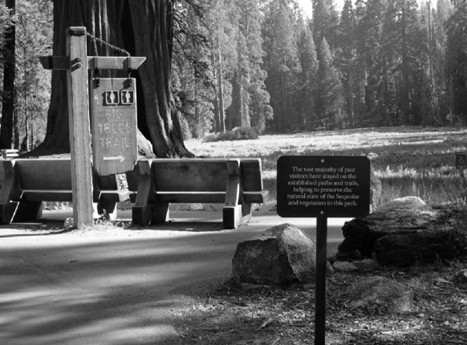
Descriptive-Prescriptive Sign at Big Trees Trail
| Title | The Impact of Normative Message Types on Off-Trail Hiking |
|---|---|
| Short description of the practice | Study on how different normative message framings in signage influence visitor behavior in Sequoia and Kings Canyon National Parks. |
| Keywords | Normative messages, Visitor behavior, Off-trail hiking, Sequoia, Signage, Resource management |
| Organisation in charge of the good practice | United States Department of Agriculture, Forest Service – Pacific Southwest Research Station |
| Implementation level of the practice | Level: National / Local (Park management)
Country: United States Region: California – Sequoia & Kings Canyon National Parks City: Riverside, California (Research Station) |
| Website | https://ec.europa.eu/environment/nature/natura2000/management/habitats?utm_source=chatgpt.com |
| Detailed information on the practice | Off-trail hiking threatens Giant Sequoias due to soil compaction and erosion. A 2004 experiment tested four types of normative messages on trail signs with ~2,900 visitors. The injunctive-proscriptive message (“Please don’t go off the trail”) reduced off-trail use to 5.1%, compared to higher rates under other messages or no sign. The least effective message was descriptive-proscriptive, which increased off-trail use. Stakeholders include USDA Forest Service, National Park Service staff, researchers, and visitors. |
| Timeframe | Field study conducted in summer 2004, results published 2007 in Journal of Interpretation Research. |
| Approximate cost | Not specified; low cost relative to enforcement—mainly sign production, installation, and observation logistics. |
| Results achieved | 2,897 visitors observed, off-trail use lowest with injunctive-proscriptive signs (5.1%), highest with descriptive-proscriptive (18.7%). Sign wording significantly influenced compliance. |
| Potential for learning or transfer | Transferable to other protected areas. Key success factors: concise, polite, negative framing (“don’t”). Constraints: effectiveness may decline over time and may require pairing with education or design changes. |
| Additional material | |
| Contact person | Name: Patricia L. Winter Affiliation: USDA Forest Service, Pacific Southwest Research Station Email: pwinter@fs.fed.us |