

Restoration of Juniperus foetidissima forests (9560*)
Picture8_24
| Title | Restoration of Juniperus foetidissima forests (9560*) |
|---|---|
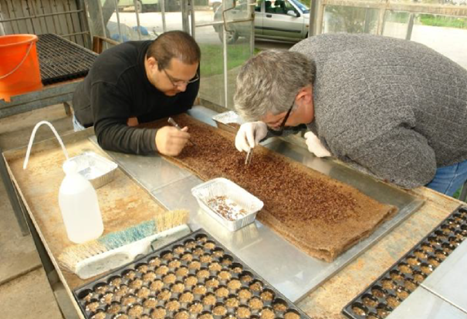
| Short description of the practice | The practice focuses on the restoration and reinforcement of degraded Juniperus foetidissima forest habitats in Mount Oiti and Kallidromo.It includes producing planting material through asexual and sexual propagation, establishing a plant nursery unit, and preparing pilot grafting trials. The final objective is to reintroduce healthy young junipers in suitable restoration plots identified through habitat assessment |
| Keywords | Seed selection ;Vegetative propagation ; Forest restoration |
| Organisation in charge of the good practice | Institute of Mediterranean and Forest Ecosystems (IMFE) |
| Implementation level of the practice | Level: Select from National / Regional
Country:Greece Region: Sterea Ellada (Central Greece) |
| Website | https://docs.google.com/document/d/1mxMDsUxqUSrQ247JeB8Rs-TGb4JfdCp6/edit#heading=h.c7bkjxg08k9c |
| Detailed information on the practice | The problem addressed is the low natural regeneration and slow growth of Juniperus foetidissima in the Oiti region, which limits reforestation and ecosystem restoration efforts. This is due to the species’ sensitive seeds, slow germination, and low survival rates under natural conditions. The context that triggered the practice was the need to increase seedling survival and growth through controlled propagation, nursery cultivation, and careful transplantation, ensuring a reliable supply of healthy plants for reforestation and conservation projects in degraded areas.The practice addresses the restoration and conservation of Juniperus foetidissima populations in the Oiti region by ensuring successful propagation, growth, and survival of the species. It achieves its objectives through a controlled process that begins with the selection and collection of seeds from healthy trees, followed by propagation in greenhouses under carefully monitored temperature, humidity, and irrigation conditions. Seedlings are nurtured in nurseries with regular watering, fertilization, and pest control, while growth and survival rates are continuously monitored. Once they reach a suitable size, seedlings are transplanted to prepared field sites in Oiti, where soil conditions are optimized and irrigation and mulching are applied to ensure establishment. The practice involves research institutes, project teams, and technical staff managing greenhouses and field planting, while the main beneficiaries include the local ecosystems, future forestry and conservation efforts, and the surrounding communities, who benefit from improved biodiversity, soil stabilization, and ecosystem services. |
| Timeframe | Based on the project experience, the practice was actively implemented during the period 2012–2014, with propagation, maintenance, and monitoring ongoing during these years. |
| Approximate cost | Not specified in the article |
| Results achieved | The practice is considered successful because it achieved an 81% survival rate of Juniperus foetidissima seedlings after nursery propagation and transplantation. Around 9,000 seedlings were produced, grown, and monitored, with consistent growth (average height 25.8 cm) and healthy development. Controlled irrigation, proper site selection, and careful handling minimized losses, demonstrating the method’s effectiveness in producing viable plants for ecosystem restoration and biodiversity enhancement. |
| Potential for learning or transfer | This practice is potentially interesting for other regions because it demonstrates a successful model for restoring Juniperus foetidissima populations in challenging environments, using a combination of nursery propagation, controlled irrigation, and careful site selection. Key success factors include the systematic selection of parent plants, monitoring of seedling growth, and the use of adaptive irrigation systems to ensure survival. Regions with similar climatic conditions, degraded soils, or biodiversity loss could replicate these techniques. Potential challenges include the need for trained staff, access to suitable nursery facilities, and sufficient funding. Transferability is enhanced by the clear protocols, measurable outcomes, and documented survival and growth rates, which provide a replicable framework for ecosystem restoration elsewhere. |
| Additional material | |
| Contact person | Name: Dr. G. Karetsos
Affiliation: Institute of Mediterranean and Forest Ecosystems (IMFE) Email: fria@elgo.gr |