| Short description of the practice |
Integrating climate indicators with forest monitoring data to assess resilience and vulnerability in Romanian forests. |
| Keywords |
forest resilience, climate change, precipitation patterns, aridity index, adaptive management, Romania |
| Organisation in charge of the good practice |
“Marin Drăcea” Romanian National Institute for Research and Development in Forestry |
| Implementation level of the practice |
Level: National Country: Romania Region: Multiple (Western Carpathians, Eastern Romania, others across 13 districts) City: Voluntari (Ilfov) / Brașov |
| Website |
https://doi.org/10.3390/f16060941?utm_source=chatgpt.com |
| Detailed information on the practice |
Climate change threatens Romanian forests through increasing droughts, heatwaves, and extreme rainfall. To address this, researchers integrated climate indices (R10mm, WSDI, aridity index) with forest management data from 2013–2022 across 13 forest districts (~400 km²). Statistical analyses (correlation matrices, PCA) identified elevation–precipitation gradients as key resilience factors. Species analysis revealed fir, beech, and spruce maintain resilience with strong regeneration, while sessile oak and hornbeam are more vulnerable to aridity. Results highlight regional differences: Western Carpathians and eastern Romania show significant precipitation changes, while western regions face more heatwaves. Stakeholders include the Romanian National Institute for Research and Development in Forestry, Transilvania University, and local forest managers. Beneficiaries are forest managers, policymakers, and biodiversity conservation programs. |
| Timeframe |
Data collection: 2013–2022 (forest data); 1950–2022 (climate data). Methodology is applicable for ongoing monitoring. |
| Approximate cost |
Not specified. Involves forest monitoring, statistical analysis, and climate datasets. |
| Results achieved |
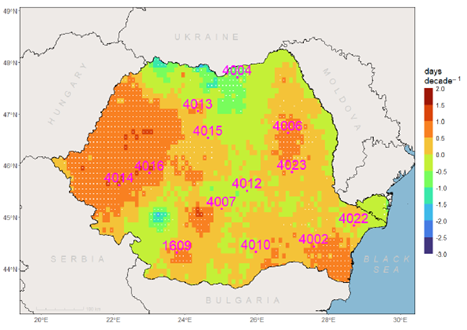
Identified climate resilience indicators: elevation–precipitation gradient explained 56.7% of variance. Fir, beech, spruce resilient; oak and hornbeam vulnerable. R10mm trends −1.4 to +1.8 days/decade; WSDI increased by ~2 days/decade. |
| Potential for learning or transfer |
This practice shows how integrating climate data with forest monitoring can guide adaptive management. Transferable to other European regions facing climate stress. Offers quantitative resilience indicators and highlights species-specific vulnerabilities. Provides actionable guidance for managers to prioritize resilient species and support vulnerable ones. |
| Additional material |
Full article: Chivulescu, S. et al. (2025). Quantifying Climate Change Impacts on Romanian Forests: Indicators of Resilience and Vulnerability. Forests, 16(6):941. |
| Contact person |
Name: Alexandru Claudiu Dobre Affiliation: Transilvania University of Brașov / “Marin Drăcea” National Institute for Research and Development in Forestry Email: dobre.alexandruclaudiu@gmail.com |