| Short description of the practice |
An integrated NDVI-InVEST model was applied in the Tianshan Mountains to assess habitat quality dynamics and drivers, guiding biodiversity protection. |
| Keywords |
Habitat quality, NDVI, InVEST model, Tianshan Mountains, biodiversity, land-use change |
| Organisation in charge of the good practice |
State Key Laboratory of Desert and Oasis Ecology, Xinjiang Institute of Ecology and Geography, Chinese Academy of Sciences |
| Implementation level of the practice |
Level : Regional Country : China Region : Xinjiang, Tianshan Mountains City : Urumqi |
| Website |
https://doi.org/10.3390/land11101805?utm_source=chatgpt.com |
| Detailed information on the practice |
This practice addresses biodiversity loss and habitat degradation in fragile mountain ecosystems under climate change and human pressure. The research team proposed an integrated framework combining NDVI with the InVEST-HQ module to improve accuracy in monitoring habitat quality (HQ). Applied to the Tianshan Mountains, the method evaluated land-use changes, spatial distribution of HQ, and driving forces over 1995–2015. It incorporated soil, precipitation, temperature, grazing, and socioeconomic factors, using a geographical detector model. Results showed significant HQ decline, glacier retreat, and grazing pressures, but also the importance of protected areas (nature parks, reserves). Stakeholders include academic researchers, conservation agencies, and regional planners. Beneficiaries are biodiversity, local communities, and ecological security strategies for Central Asia. |
| Timeframe |
Study period: 1995–2015. The framework can be used for continuous monitoring and policy planning. |
| Approximate cost |
Not specified. Requires access to remote sensing datasets (NDVI, DEM, land-use), GIS processing, and InVEST modelling tools. |
| Results achieved |
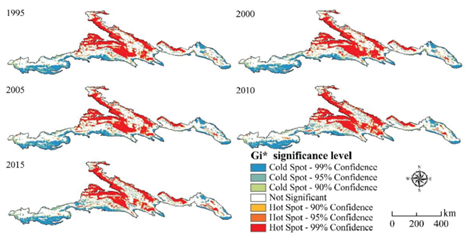
Average HQ in Tianshan declined from 0.5044 (1995) to 0.4802 (2015). Hot spots: Ili River Valley and Kaidu River Basin; cold spots: south and east. Protected areas maintained higher HQ (>0.6) versus unprotected (<0.5). |
| Potential for learning or transfer |
This integrated NDVI-InVEST approach improves habitat quality monitoring in data-poor regions. Transferable to other mountain ecosystems and arid/semi-arid landscapes worldwide. It strengthens ecological protection planning, highlights soil/climate/grazing as key drivers, and supports design of more effective protected area networks. |
| Additional material |
Full article : Lu, Y. et al. (2022). Monitoring the Spatiotemporal Dynamics of Habitat Quality and Its Driving Factors based on the Coupled NDVI-InVEST Model : A Case Study from the Tianshan Mountains in Xinjiang, China. Land 11(10):1805. |
| Contact person |
Name : Fang Han Affiliation : Xinjiang Institute of Ecology and Geography, Chinese Academy of Sciences Email : hanfang@ms.xjb.ac.cn |