| Short description of the practice |
Distance sampling of pellet groups provided roe deer density estimates in northeastern Portugal, supporting conservation and management. |
| Keywords |
roe deer, density estimation, distance sampling, pellet counts, wildlife monitoring, Portugal |
| Organisation in charge of the good practice |
CESAM – Department of Biology, University of Aveiro, Portugal |
| Implementation level of the practice |
Level: Regional Country: Portugal Region: Northeastern Portugal (Montesinho Natural Park, Serra da Nogueira, Lombada NHA) City: Aveiro |
| Website |
https://doi.org/10.1371/journal.pone.0088459?utm_source=chatgpt.com |
| Detailed information on the practice |
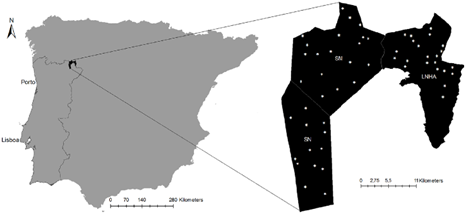
Roe deer populations have expanded across Europe, with ecological and socio-economic impacts. In Portugal, knowledge of roe deer density was lacking. This study applied distance sampling of pellet groups, combined with production and decay rates, to estimate roe deer density in three areas of northeastern Portugal: Serra de Montesinho (SM), Serra da Nogueira (SN), and Lombada National Hunting Area (LNHA). A total of 54 transects (21.6 km effort) were surveyed between January 2012 and February 2013. 307 pellet groups were recorded, and detection modeled with a half-normal function. Density estimates were 1.23/100 ha in LNHA, 4.87/100 ha in SM, 4.25/100 ha in SN, and overall 3.51/100 ha (95% CI: 2.26–5.45). The method proved feasible and robust for ungulate monitoring, with relatively low costs compared to direct methods. Stakeholders: University of Aveiro, Instituto da Conservação da Natureza e Florestas, local hunting associations. Beneficiaries: wildlife managers, hunters, conservationists, and policy makers. |
| Timeframe |
Field surveys: January 2012 – February 2013. Method applicable for long-term monitoring with regular repetitions. |
| Approximate cost |
Not detailed. Requires field teams for transect surveys, GPS equipment, and analysis software (Distance). Lower cost than capture-mark-resight. |
| Results achieved |
Density estimates with acceptable precision (CV < 31%). Higher densities in Serra de Montesinho and Serra da Nogueira; lower in LNHA. Provides first baseline for roe deer populations in Portugal. |
| Potential for learning or transfer |
The study demonstrates the usefulness of pellet group distance sampling for monitoring ungulates in areas with difficult visibility and limited resources. Transferable to other regions and species. Supports design of sustainable hunting quotas, conservation strategies, and wolf–prey management. Future work should expand study areas and assess interspecific competition with red deer. |
| Additional material |
Full article: Valente, A.M. et al. (2014). Living on the Edge: Roe Deer (Capreolus capreolus) Density in the Margins of Its Geographical Range. PLoS ONE 9(2): e88459. |
| Contact person |
Name: Rita Tinoco Torres Affiliation: CESAM – Department of Biology, University of Aveiro Email: rita.torres@ua.pt |