

Detecting Plant Species in the Field With Deep Learning and Drone Technology
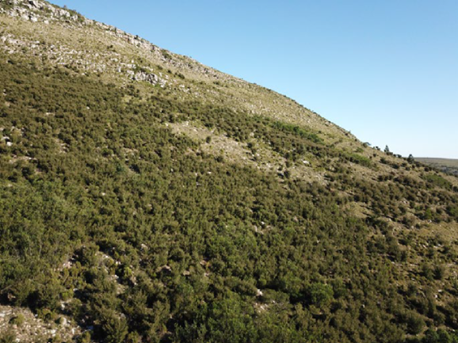
Typical invasion of Hakea on a grassy slope with other scattered shrubs
| Title | Detecting Plant Species in the Field With Deep Learning and Drone Technology |
|---|---|
| Short description of the practice | Commercial drones integrated with deep learning models detect invasive plants in the field, improving precision and enabling real-time monitoring. |
| Keywords | aerial imagery, deep learning, drones, invasive plants, U-Net, remote sensing |
| Organisation in charge of the good practice | Department of Computer Science, Rhodes University, Grahamstown, South Africa |
| Implementation level of the practice | Level: Regional/National Country: South Africa Region: Eastern Cape (Grahamstown area) City: Grahamstown |
| Website | https://doi.org/10.1111/2041-210X.13473?utm_source=chatgpt.com |
| Detailed information on the practice | Traditional plant detection studies rely on orthomosaics and off-board processing, creating delays and limiting real-world use. This practice introduces a deep learning U-Net segmentation model integrated with a DJI Mavic Pro drone to detect invasive alien plants (Hakea genus) directly in the field. Datasets were collected from Eastern Cape, South Africa, and annotated for training. Model training used data augmentation (flips, rotations, brightness variation) and weight map-based loss to handle uncertainty in plant edges. Integration with a custom Android app allowed real-time segmentation overlays during drone flights. Stakeholders: Rhodes University, conservationists, land managers in the fynbos biome. Beneficiaries: ecological researchers, biodiversity managers, and invasive species control programs. |
| Timeframe | Dataset collected over two months; field trials conducted in early winter. The methodology is adaptable for ongoing monitoring. |
| Approximate cost | Not specified. Involves DJI Mavic Pro drone, Android devices, annotation labor, and computing resources for model training. Lower cost than satellite/hyperspectral approaches. |
| Results achieved | Final model achieved F1-score of 83% and accuracy of 96% on the test set. Field trials achieved recall of 75% with in-flight detection capability. Brightness augmentation improved F1-score by 27%; weight map-based loss improved precision by 15%. |
| Potential for learning or transfer | Demonstrates that real-time deep learning detection on drones is feasible for invasive species monitoring. Transferable to other species or environments where rapid, on-site detection is critical. Offers potential for intelligent drone interactions (closer inspection, bio-control delivery). Limitations: high false positives, seasonal variation effects, and dependence on annotated training data. |
| Additional material | Full article: James, K., & Bradshaw, K. (2020). Detecting Plant Species in the Field With Deep Learning and Drone Technology. Methods in Ecology and Evolution 11:1509–1519. |
| Contact person | Name: Katherine James Affiliation: Department of Computer Science, Rhodes University Email: katherine.mf.james@gmail.com |