| Short description of the practice |
Through GLORIA, Mt Olympus tracks climate change impacts on alpine habitats using permanent plots and soil temperature sensors |
| Keywords |
Biodiversity monitoring, Endemic plants, Conservation, Soil temperature sensors, Alpine |
| Organisation in charge of the good practice |
Forest Research Institute – Hellenic Agricultural Organization DIMITRA (ELGO-DIMITRA) in collaboration with the Management Unit of Mt Olympus National Park (under N.E.C.C.A.’s Protected Areas Management Directorate) |
| Implementation level of the practice |
Level: Local Country: Greece Region: Mt Olympus |
| Website |
https://www.gloria.ac.at/home |
| Detailed information on the practice |
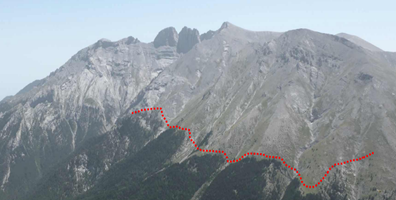
Climate change is increasingly affecting alpine ecosystems, which are particularly sensitive due to their altitude, limited resilience, and presence of rare endemic species. Mt Olympus, a UNESCO Biosphere Reserve and National Park, hosts unique plants such as Jankaea heldreichii, making it an ideal site to monitor biodiversity responses to rising temperatures. To address this need, in 2021 the mountain was integrated into the international GLORIA network, which applies a standardized methodology for long-term monitoring of alpine habitats. The practice involves the establishment of four summits at elevations between 2.083 and 2.808 m. On these summits, 64 permanent 1×1 m plots and 32 larger summit plots were created, while 16 soil temperature sensors continuously record data at hourly intervals. Vegetation surveys are repeated every 5-7 years using identical methods, thus creating robust time-series to detect climate-driven biodiversity changes, including shifts in species composition and potential impacts on endemic plants. The initiative is coordinated by the Forest Research Institute of ELGO-DIMITRA in cooperation with the Management Unit of Mt Olympus National Park, with support from the GLORIA network. Main stakeholders include researchers, conservation managers and policy makers, while beneficiaries are the scientific community, national and local authorities, and ultimately the fragile alpine ecosystems of Mt Olympus. |
| Timeframe |
Implemented in 2021 with the installation of plots and sensors. The practice is ongoing, with continuous monitoring and surveys every 5-7 years. |
| Approximate cost |
Not explicitly reported. Costs involve the purchase and installation of soil temperature sensors, the establishment of permanent plots and fieldwork campaigns. Compared to repeated large-scale surveys, the standardized GLORIA approach is relatively cost-effective, as long-term monitoring relies mainly on periodic resurveys and institutional support. |
| Results achieved |
Initial vegetation surveys were carried out in 2021 on four summits of Mt Olympus, with 64 permanent plots and 16 soil temperature sensors installed. Continuous data collection is underway, providing the first long-term dataset for alpine habitats in northern Greece within the international GLORIA network. Initial results have demonstrated that elevation was the dominant factor influencing vegetation changes along the examined gradients [2]. |
| Potential for learning or transfer |
This practice shows that standardized alpine monitoring can be implemented even under demanding high-altitude conditions. It could be applied in other mountain areas where endemic plants and fragile habitats face increasing climate pressures. By combining permanent plots with simple soil sensors, it provides reliable information while keeping costs relatively low. |
| Additional material |
[1] DIMITRA Magazine, Issue 33 (2022), ELGO-DIMITRA. Includes reference to the GLORIA project on Mt Olympus. [2] Xystrakis, F., Poulis, G., Damianidis, C., Sakellarakis, F. N., Tsachouridis, M., Eleftheriadou, A., & Chatzitriantafyllou, M. (2023). Floristic, chorological and life-form patterns at the highest summits of Mt Olympus, Greece. Botany Letters, 171(2), 253–266. https://doi.org/10.1080/23818107.2023.2276690. |
| Contact person |
Name: Triantafyllos Bitos Affiliation: Management Unit of Mt Olympus National Park Email: botrs1313@gmail.com |