| Short description of the practice |
Long-term analysis (2008–2022) of revenue sources for Serbia’s national parks highlights the dominance of business revenues and the need for diversification. |
| Keywords |
protected areas, national parks, financing, Serbia, sustainable management, biodiversity conservation |
| Organisation in charge of the good practice |
Institute of Forestry, Belgrade, Serbia |
| Implementation level of the practice |
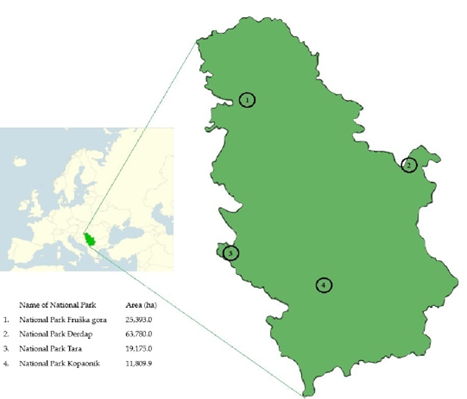
Level: National Country: Serbia Region: Various (NP Tara, NP Đerdap, NP Fruška Gora, NP Kopaonik) City: Belgrade |
| Website |
https://doi.org/10.3390/f16060963?utm_source=chatgpt.com |
| Detailed information on the practice |
Protected areas (PAs) are vital for biodiversity, ecosystem services, and cultural heritage. Serbia protects 9.74% of its land, with national parks (NPs) covering 17.3% of all PAs. Sustainable financing remains a major challenge, as NP managers rely heavily on business revenues, mainly from wood production. This study analyzed financial data from four NPs (Tara, Đerdap, Fruška Gora, Kopaonik) for 2008–2022, categorizing revenues into business, fee, grant, and other business revenues. Regression models showed business revenues are the most significant contributor to total revenues, with fee and grant revenues also important but less impactful. Fee revenues grew strongly in NP Kopaonik due to improved collection systems, while NP Đerdap consistently underperformed in revenue generation. Grant revenues spiked irregularly when government or international funds supported infrastructure or tourism projects. Results highlight the need to diversify funding (e.g., fees, grants, ecosystem services, tourism), strengthen government support, and reduce overreliance on wood production to align with conservation objectives and EU accession demands. Stakeholders: Institute of Forestry, Faculty of Forestry University of Belgrade, BOKU University, Ministry of Environmental Protection. Beneficiaries: national park managers, conservationists, policymakers, and local communities. |
| Timeframe |
Financial data analyzed: 2008–2022. Method applicable for ongoing monitoring and future planning. |
| Approximate cost |
Not specified. Requires continuous financial reporting, monitoring, and policy support. |
| Results achieved |
Business revenue = strongest driver of NP finances. Fee revenues significantly increased in NP Kopaonik after 2019. Grant revenues sporadic but supportive in specific years. Regression models explain >99% of variation in NP revenues. |
| Potential for learning or transfer |
The Serbian case illustrates how overreliance on wood production undermines conservation goals. Diversification of funding through fees, grants, and tourism revenues can increase sustainability. Transferable to other countries with limited government budgets. Highlights the importance of transparent reporting, innovative fee collection systems, and stronger state and international support. Demonstrates that EU accession and biodiversity strategies require more balanced financing models. |
| Additional material |
Full article: Đorđević, I. et al. (2025). An Analysis of National Park Financing Mechanisms in Serbia. Forests 16(6):963. |
| Contact person |
Name: Ilija Đorđević Affiliation: Institute of Forestry, Belgrade Email: ilija.djordjevic@forest.org.rs |